1099 Compliance Management for US Rental Property Portfolios
Managing 1099 compliance across US rental property portfolios requires more than year-end filing. This case study explores how structured vendor tracking, W-9 collection, AP review, and filing coordination helped streamline 1099 workflows across multifamily, SFR, MHP, and RV park operations managing hundreds of vendors and multiple entities.
1099 COMPLIANCE
Aditya Kumar
5/25/20266 min read
1099 Compliance Management for US Rental Property Portfolios
Managing Vendor Records, W-9 Collection, AP Reviews, and Filing Coordination Across Multifamily, SFR, MHP, and RV Park Operations
For many US rental property operators, 1099 reporting becomes one of the most operationally difficult accounting processes of the year. On paper, the requirement sounds relatively straightforward: identify eligible vendors, verify tax information, calculate annual payments, and issue the required forms before filing deadlines.
In practice, however, the process becomes significantly more complicated once a rental portfolio begins scaling across multiple properties, entities, asset classes, and operating teams.
This is especially true in portfolios involving:
Multifamily properties
Single-family rentals (SFRs)
Mobile home parks (MHPs)
RV park operations
These operations often involve hundreds of vendors spread across maintenance, repairs, utilities, landscaping, plumbing, electrical work, legal services, turnover projects, and recurring operational support. Vendor activity flows through multiple bank accounts, several ownership entities, and different accounting platforms, while accounting teams are simultaneously trying to maintain accurate records throughout the year.
The portfolios we supported ranged from smaller SFR and multifamily operations to RV park portfolios managing as many as 1,300 pads. Across all entities combined, vendor counts could approach or exceed 1,000 individual records.
At that scale, 1099 compliance stops being a simple year-end filing task and becomes an ongoing accounting workflow requiring consistent monitoring, cleanup, reconciliation, and vendor management throughout the year.
The Accounting Environment
The accounting infrastructure itself was spread across several commonly used property accounting platforms, including:
AppFolio
Buildium
Rent Manager (RM)
QuickBooks Online (QBO)
Each platform served different operational needs depending on the portfolio structure and ownership setup. While these systems handled property accounting and accounts payable activity effectively, they did not eliminate the operational challenges associated with 1099 compliance.
In reality, property management software reflects transactional activity, but year-end reporting accuracy still depends heavily on the quality of vendor records maintained throughout the year.
This became particularly visible during vendor reviews.
Some vendors were entered multiple times under slightly different names. Others were missing tax identification information entirely. Certain contractors had received payments across multiple entities, while some vendor profiles lacked even basic contact information such as email addresses required for follow-up communication.
As the portfolios grew, maintaining clean vendor data became just as important as processing the underlying transactions themselves.
The Operational Problems Behind 1099 Reporting
One of the most common problems involved missing W-9 documentation.
In rental property operations, vendors are added continuously throughout the year. Repair technicians, plumbers, electricians, landscapers, turnover contractors, pressure washing vendors, maintenance providers, and local service operators are often onboarded quickly to support ongoing operational needs. In many cases, operational urgency takes priority over documentation completeness.
As a result, vendors were sometimes paid before proper tax documentation had been collected.
This issue was particularly common with smaller non-incorporated service providers. Some vendors delayed responding to documentation requests for weeks or months, while others ignored requests entirely. Occasionally, accounting teams discovered during year-end review that no W-9 had ever been requested in the first place.
Missing email addresses created another layer of difficulty. Certain vendors existed in the accounting system with only phone numbers or incomplete contact records, making follow-up communication inconsistent and time-consuming.
Duplicate vendors were another recurring issue.
The same contractor might appear:
under multiple spellings,
under both personal and DBA names,
across separate ownership entities,
or inside different accounting systems entirely.
Without cleanup and consolidation, annual payment totals could become fragmented, increasing the risk of inaccurate threshold calculations or duplicate filings.
Vendor classification problems also surfaced regularly during review processes.
Not every vendor receiving payments necessarily requires 1099 reporting. Vendors providing goods rather than services are often excluded, while incorporated entities may not require filing treatment under standard rules. However, attorneys and legal professionals frequently require separate consideration regardless of corporate structure.
Over time, accounting records naturally accumulate inconsistencies. Vendors initially marked as corporations may later turn out to be non-incorporated operators. Others may have been coded incorrectly during onboarding. Some contractors working across several properties may have inconsistent entity classifications across systems.
These inconsistencies become extremely difficult to untangle once year-end filing pressure begins.
Moving Away From Reactive Year-End Cleanup
One of the largest operational improvements came from changing the timing of the process itself.
Rather than treating 1099 work as a January filing exercise, the workflow was integrated into ongoing accounting operations throughout the year.
The goal was not simply to prepare forms faster. The objective was to reduce year-end uncertainty by improving vendor visibility continuously.
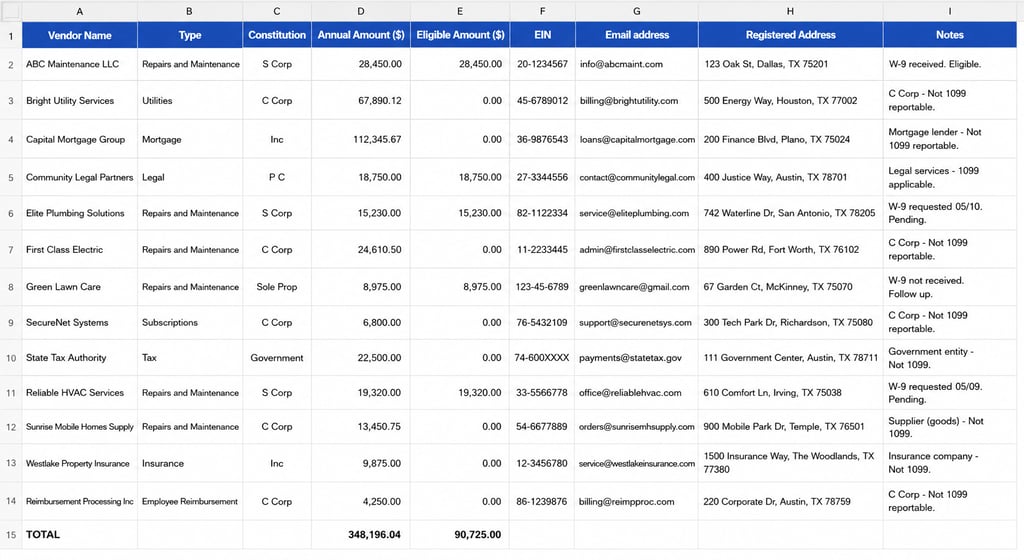
To support this, a centralized vendor tracking process was maintained separately from the property management systems themselves.
The tracking workflow monitored:
W-9 collection status
Vendor classification
Missing EIN or TIN information
Vendor contact records
Filing eligibility
Vendors approaching annual payment thresholds
Duplicate vendor activity across entities
Maintaining this information outside the accounting systems created a much clearer operational picture of vendor compliance readiness.
This proved especially valuable for portfolios operating across multiple entities where contractors regularly performed work for several ownership groups simultaneously.
Accounts Payable Review as Part of Compliance Management
Accounts payable review became one of the most important components of the process.
Instead of waiting until year-end to identify filing issues, vendor activity was reviewed periodically throughout the year as invoices and payments flowed through the system.
New vendors were examined to determine whether they were likely to become reportable service providers. Repair and maintenance vendors received particular attention because they represented a significant portion of recurring operational payments across SFR, MFR, MHP, and RV park portfolios.
During AP review, several questions were continuously evaluated:
Is the vendor incorporated?
Has a W-9 already been collected?
Are vendor records duplicated elsewhere?
Is the vendor being paid across multiple entities?
Is the vendor approaching reporting thresholds?
Does the nature of the expense indicate likely filing eligibility?
By reviewing these issues proactively, year-end filing preparation became significantly more manageable.
W-9 Collection and Vendor Follow-Up
W-9 collection itself was rarely a simple administrative task.
For vendors missing documentation, email outreach was conducted requesting updated W-9 information. Follow-up communication often became necessary, particularly with smaller field contractors who were unfamiliar with reporting requirements or simply unresponsive.
In practice, some vendors responded immediately while others required multiple reminders over extended periods.
The challenge was not simply collecting forms. It was maintaining enough operational discipline to ensure missing documentation did not remain unnoticed until filing season.
As vendor records improved over time, year-end reviews became much more efficient because much of the underlying cleanup had already been completed gradually throughout the year.
Managing Vendors Across Multiple Entities
One of the more complex aspects of the workflow involved contractors operating across several ownership entities.
This situation was common across rental portfolios.
A landscaping company might service multiple RV parks under separate LLCs. A maintenance contractor could perform turnover work for both multifamily and SFR operations. Attorneys and legal professionals frequently invoiced several entities throughout the year.
Without proper aggregation and review procedures, vendor payments could easily become fragmented across systems.
This created several risks:
underreporting vendor totals,
duplicate reporting,
inconsistent classification treatment,
and incomplete payment visibility.
To address this, vendor records were reviewed and standardized regularly so payment activity could be consolidated accurately across portfolios.
Threshold Monitoring and Filing Preparation
Threshold tracking was handled through periodic annual vendor reviews.
The focus remained primarily on non-incorporated service providers while generally excluding incorporated vendors and goods-only suppliers where appropriate. Vendor populations were refined continuously to avoid unnecessary filing review work while ensuring reportable vendors remained visible.
As filing season approached, the operational advantage of maintaining these procedures throughout the year became increasingly clear.
Instead of beginning with a large-scale cleanup project in January, the accounting team already had:
updated vendor classifications,
collected W-9 records,
reviewed payment activity,
monitored threshold exposure,
and cleaned duplicate vendor records throughout the year.
This substantially reduced year-end pressure.
Filing Coordination Through Tax1099
Once payment reviews and vendor validations were completed, filing coordination was managed using Tax1099.
Vendor information and payment data were reviewed carefully prior to upload to reduce filing errors and incomplete submissions. Tax1099 was then used to manage electronic distribution workflows and filing communication with vendors.
Because much of the vendor cleanup had already been completed earlier in the process, filing preparation became significantly more controlled and predictable.
Operational Impact Across Rental Portfolios
The most important improvement was not simply faster filing preparation. It was improved operational visibility across the entire accounts payable and vendor management process.
Vendor records became cleaner and more standardized. Duplicate vendors were identified earlier. Missing tax documentation became easier to track. Contractor activity across entities became more transparent.
Most importantly, accounting teams spent less time reacting to preventable problems during filing season.
For growing US rental property operations, especially those managing multifamily portfolios, SFRs, mobile home parks, and RV parks, 1099 compliance is ultimately an operational accounting discipline rather than a once-a-year tax task.
The complexity does not come from filing the forms themselves. It comes from maintaining accurate vendor data across hundreds of transactions, multiple entities, recurring contractors, and constantly changing operational environments.
By integrating vendor monitoring, W-9 collection, AP review, threshold tracking, and filing coordination into regular accounting workflows, rental property operators can significantly reduce compliance risk while improving the reliability of their year-end reporting process.
Conclusion
For growing US rental property operations, 1099 compliance requires much more than generating forms at year-end. The real challenge lies in maintaining accurate vendor records, monitoring contractor payments across entities, collecting W-9 documentation proactively, and ensuring reporting readiness throughout the year.
As portfolios scale across multifamily properties, single-family rentals, mobile home parks, and RV park operations, vendor management becomes closely tied to overall accounting discipline. Duplicate vendors, incomplete tax documentation, fragmented payment histories, and inconsistent classifications can quickly create operational inefficiencies if not addressed through structured workflows.
At Brookeside Accounting Services, we support US rental property operators with accounting workflows built around the operational realities of property management — including vendor compliance management, accounts payable review, reporting support, and year-end 1099 coordination across SFR, MFR, MHP, and RV park portfolios.
If your operation is dealing with missing W-9s, duplicate vendor records, fragmented AP workflows, or recurring year-end filing pressure, we would be happy to discuss your current accounting process and operational challenges.
Schedule a Free Consultation:
Brookeside Accounting Services
Contact
Find us on LinkedIn and Facebook
Phone
contact@brookesideaccounting.services
+1 857-208-7210
© 2025. All rights reserved.
QUERIES