How Utility Vendors Overcharge Rental Properties (And How to Catch It)
Find out how utility vendors overcharge rental property owners, the warning signs to watch for, and how to recover money you're owed.
ACCOUNTS PAYABLE
Aditya Kumar
3/18/20265 min read
How Utility Vendors Overcharge Rental Properties (And How to Catch It)
Find out how utility vendors overcharge rental property owners, the warning signs to watch for, and how to recover money you're owed.
A $7,930 Problem Hidden in Plain Sight
In December 2025, one of my most valued clients — Roger, an Ohio-based rental property owner — reached out alarmed. The electric utility bill for one of his properties had jumped from $51.19 to $272.39 in a single billing period. No occupancy changes. No new appliances. No explanation from the utility company.
As his rental property accountant, I immediately got to work. What I uncovered wasn't just a billing spike — it was 17 months of estimated meter readings that had silently overcharged Roger's account, resulting in a refund claim of $7,930.52.
This is more common than most rental property owners realize. And it is almost always invisible without a structured system to catch it.
What Are "Estimated Meter Readings" and Why Are They Dangerous?
Utility companies don't always send someone to physically read your meter. When they can't — due to access issues, staffing, or simply convenience — they estimate your usage based on historical averages.
The problem? These estimates can be wildly inaccurate, especially if:
The property had different occupancy in prior periods
Seasonal usage changed significantly
The estimation model is outdated or based on incorrect baselines
For rental property owners managing multiple units across multiple addresses, a single estimated reading slipping through undetected can quietly compound into thousands of dollars of overcharging over months or years.
In Roger's case, the utility company had been estimating his meter for 17 consecutive months before anyone noticed.
Why This Is So Easy to Miss
Most rental property owners are managing dozens of utility accounts across multiple properties. Manually comparing each bill to the previous period, every single month, is simply not realistic.
Without a structured monitoring system in place, here is what typically happens:
Bills are paid as they arrive without comparison to prior periods
Estimated readings are not flagged on the invoice in an obvious way
Property management software like Buildium or AppFolio posts the bill and moves on
The discrepancy compounds silently for months or years
Roger's situation was caught only because the December spike was dramatic enough to raise alarm. Most estimated-reading overcharges are subtle — a 10% or 15% creep month over month that never triggers concern until it becomes a very large number.
The Solution: A Simple Utility Bill Variation Tracker
When Roger asked me to build an alert system that would flag any utility bill higher than 50% of the previous period, I had one clear requirement of my own: no new subscriptions, no scripting, no debugging rabbit holes.
We already use Buildium for self-managed properties, AppFolio for third-party managed rentals, and QuickBooks Online for the management company entity. The last thing a lean operation needs is another tool added to the stack.
The solution was a structured spreadsheet — fast to build, easy to maintain, and immediately readable.
Step 1: Build the AP Schedule with Variance Tracking
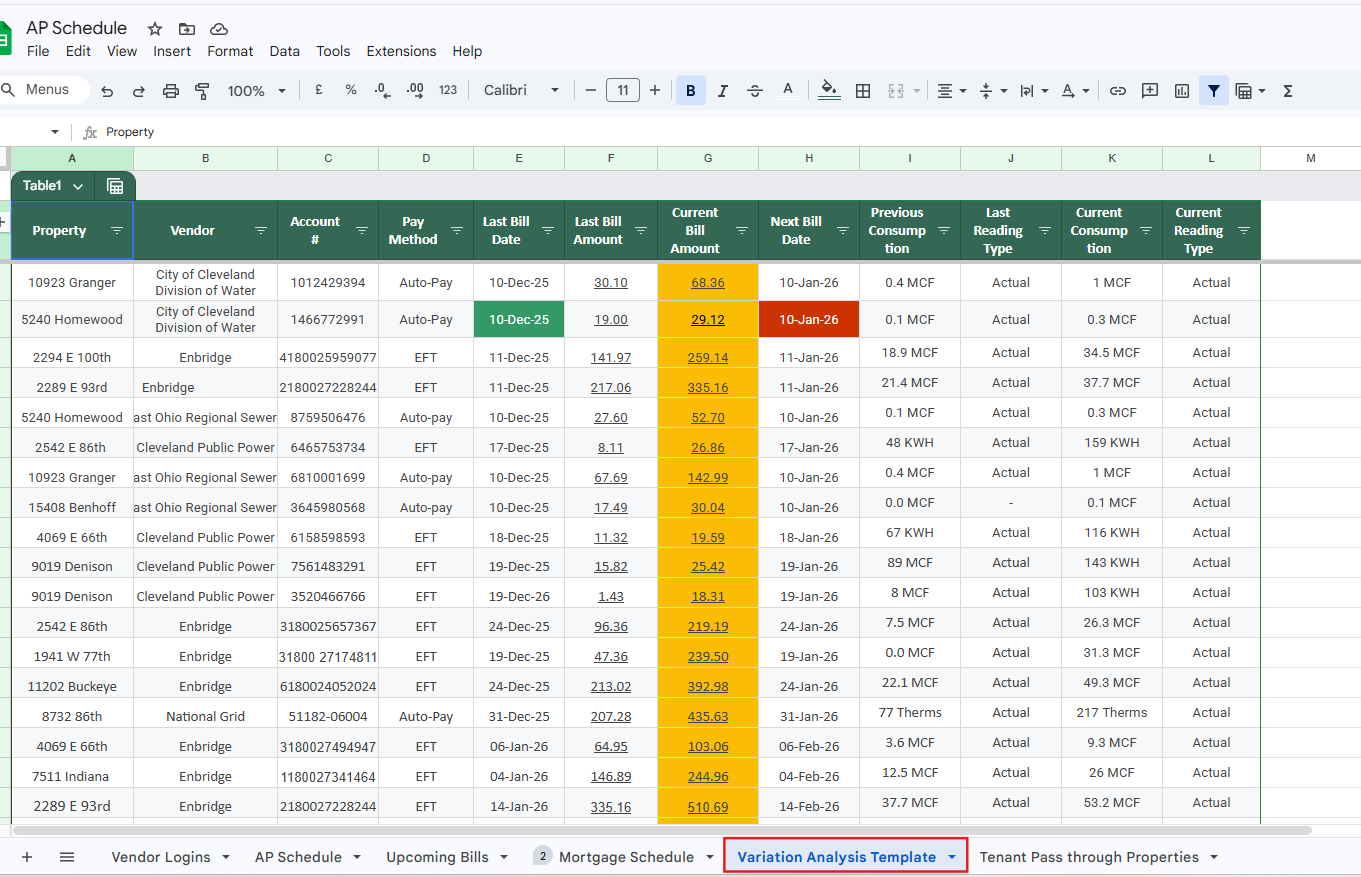
We already maintain a sophisticated Accounts Payable Schedule for each client — a single consolidated view of every utility account across the entire portfolio. Think of it as a master utility dashboard: vendor name, account number, property address, payment method, last bill date, and last bill amount, all in one place.
To this existing structure, I added one new column: Current Bill Amount (Column K).
Column K sits directly beside the Last Bill Amount column, so you can see both figures side by side at a glance.
Column K is conditionally formatted with a simple rule: if the current bill is 50% or more higher than the previous bill, the cell turns red.
That's it. No formulas beyond a basic percentage comparison. No macros. No automation to maintain. Just a visual flag that demands attention.
Step 2: Build the Exception Sub-List
When one or more cells light up red, we generate a focused sub-list of just those flagged accounts and add three additional columns:
Last meter reading
Current meter reading
Reading basis — Actual or Estimated, pulled directly from the bill
This sub-list is then sent to the client for review before any payment is posted to Buildium or AppFolio.
The reading basis column is the critical one. If the current bill says "Estimated" in that field, that is your signal to pause, investigate, and push back on the utility company before paying.
No bill gets posted until the client gives the go-ahead. Peace of mind for the owner. Peace of mind for the accountant.
What We Found in Roger's Portfolio
Once the tracker was in place and we ran a full audit of Roger's Ohio portfolio, here is what the investigation revealed:
The flagged property had been billed on estimated readings for 17 consecutive months
The refund claim for calendar year 2024 alone came to $7,930.52
An immediate sweep of all accounts with the same electric utility provider identified 3 additional properties running on estimated meter reads for over a year
All four accounts are now in active dispute, with actual consumption data requested and excess charges being refunded
One structured spreadsheet. Four overcharged accounts caught. Nearly $8,000 in refunds recovered — and counting.
Warning Signs That Your Utility Vendor May Be Overcharging You
Based on this experience and others like it, here are the red flags to watch for on any rental property utility bill:
"Estimated" appears in the meter reading section — this is the clearest indicator
A sudden spike with no corresponding occupancy or seasonal change
The same bill amount appearing for two or more consecutive months — a sign estimates are being rolled forward
Usage figures that don't align with the property type or size
Lack of a physical meter read date on the invoice
If you are managing more than five utility accounts and do not have a variance tracking system in place, the question is not whether you are being overcharged — it is by how much.
How to Request a Refund From Your Utility Vendor
If you identify estimated readings that have resulted in overcharging, here is the process we follow for our clients:
Request the full billing history for the account going back 24 months
Request actual meter reads for all periods marked as estimated
Calculate the variance between what was charged and what actual consumption would have cost
Submit a formal dispute in writing to the utility company's billing department
Follow up in writing every 14 days until the refund is confirmed
Utility companies are not always forthcoming with refunds. Persistence and documentation are essential. Having a detailed AP Schedule with all historical bill amounts already recorded significantly strengthens your position.
Why Rental Property Owners Need a Structured AP System
Roger's story is not unusual. What made it recoverable was having a professional accounting system in place that could respond quickly, audit systematically, and present findings clearly.
Without that infrastructure, most property owners would have continued paying estimated bills indefinitely.
A well-structured Accounts Payable system for rental properties should give you:
A single consolidated view of every utility account across your entire portfolio
Month-over-month variance tracking to flag anomalies automatically
Clear documentation of reading types (Actual vs. Estimated)
Client approval workflows before any bill is posted or paid
Audit trails that support dispute claims with utility vendors
This is exactly what Brookeside Accounting builds and maintains for every client.
Protecting Your Portfolio Going Forward
Utility overcharging is a silent drain on rental property profitability. It rarely announces itself. It compounds quietly. And it is almost always recoverable — if you catch it in time.
At Brookeside Accounting, we work across Buildium, AppFolio, and QuickBooks Online to give rental property owners complete visibility into every dollar flowing in and out of their portfolios. Our AP monitoring system flags utility anomalies before they become expensive problems — and when they do occur, we have the documentation and process to recover what you are owed.
If you are managing rental properties in the US and do not have a utility variance tracking system in place, now is the time to build one.
Ready to protect your rental property portfolio from utility overcharging? Book a free consultation with Brookeside Accounting and let us audit your current AP setup.
Brookeside Accounting provides specialized real estate accounting services for rental property owners and managers across the United States, working remotely with clients through Buildium, AppFolio, QuickBooks Online, and Xero.
Contact
Find us on LinkedIn and Facebook
Phone
contact@brookesideaccounting.services
+1 857-208-7210
© 2025. All rights reserved.
QUERIES