Tenant Delinquency Tracking: How to Protect Your Rental Cash Flow
Discover how to build a tenant health tracker, spot delinquency early, and protect your rental property cash flow before it becomes a problem.
TENANT MANAGEMENT
Aditya Kumar
3/22/20266 min read
Tenant Delinquency Tracking: How to Protect Your Rental Cash Flow
Discover how to build a tenant health tracker, spot delinquency early, and protect your rental property cash flow before it becomes a problem.
"My P&L Looks Strong… But Why Don't I Have Cash in the Bank?"
This is one of the most common things we hear from rental property owners. The Income Statement shows solid net income. The bank account tells a very different story.
In one recent case, a property owner came to us confused:
Net Income: $81,200
Cash in Bank: $7,700
At first glance, it feels like an accounting error. It isn't. The books were correct. The problem was visibility — or rather, the complete lack of it.
Here is where the money actually was:
$63,500 tied up in uncollected rent sitting in Accounts Receivable
$10,000 already deployed into equipment purchases
A small number of tenants were responsible for a large portion of that outstanding balance. The cash wasn't missing — it was sitting with specific tenants who hadn't paid, while the P&L continued to record income as if it had been collected.
This is the single most common cash flow problem in rental property portfolios. And it is almost always invisible without the right tracking system in place.
Why Your P&L Is Not Enough
The Profit and Loss statement is an essential financial report — but it has a critical limitation for rental property owners: it tells you how much is owed, not who owes it, how long it has been outstanding, or how concentrated your risk really is.
Consider what a P&L cannot tell you:
Which specific tenants are driving your A/R balance
Whether your largest outstanding balance is 30 days old or 6 months old
What percentage of your total A/R is concentrated in just 2 or 3 tenants
Which tenants are consistently late vs genuinely delinquent
Where to focus your collection efforts this week
A P&L gives you the total. A Tenant Health Tracker gives you the breakdown — and the breakdown is where the actionable information lives.
The A/R Concentration Problem
One of the most important insights we share with new clients is this: Accounts Receivable is rarely evenly distributed.
In most rental property portfolios, a small number of tenants account for the majority of outstanding balances. This is sometimes called the 80/20 pattern — roughly 80% of your A/R risk is concentrated in roughly 20% of your tenants.
This matters because:
A portfolio with $63,500 in A/R spread evenly across 50 tenants is very different from the same balance concentrated in 3 tenants
Concentrated A/R means concentrated cash flow risk — if one or two high-balance tenants vacate or default, the impact is immediate and significant
Without visibility into that concentration, you cannot prioritise collection efforts or make informed decisions about lease renewals
The only way to see this clearly is with a structured tenant-level tracking system.
What Is a Tenant Health Tracker?
A Tenant Health Tracker is a structured report — typically a spreadsheet — that gives you a complete, real-time view of every tenant's payment status, outstanding balance, and collection history across your entire portfolio.
Unlike a standard A/R aging report, a Tenant Health Tracker is designed to be readable and actionable — not just a data dump. You do not need to be a spreadsheet expert to understand it.
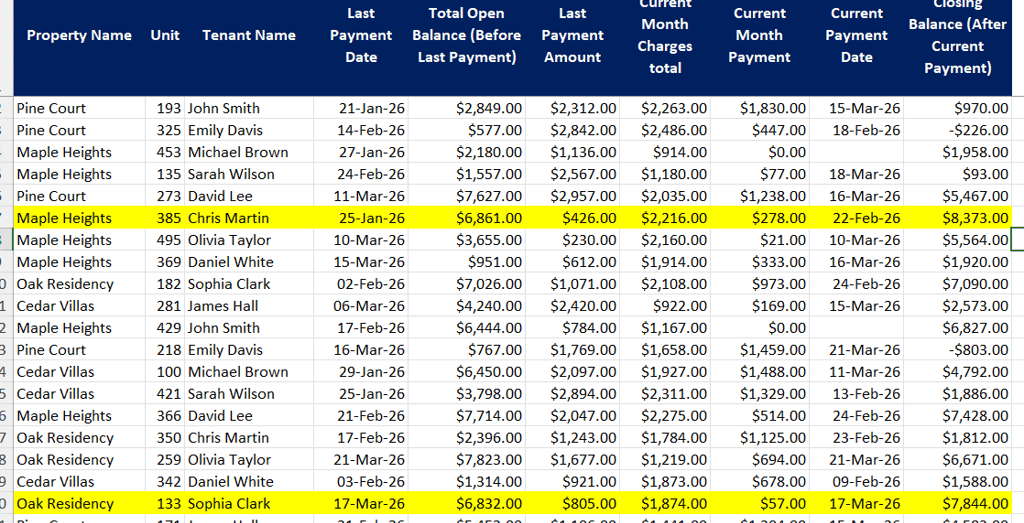
At Brookeside Accounting, the trackers we build for US rental property owners typically include the following fields for every tenant:
Property Name and Unit — so you can immediately locate the tenant
Tenant Name — the individual or entity responsible for payment
Last Payment Date — when money was last received
Total Open Balance (Before Last Payment) — what was owed going into the last payment cycle
Last Payment Amount — what was actually paid
Previous Month Charges — what was billed in the prior period
Current Month Charges — what is billed in the current period
Current Month Payment — what has been received so far this month
Current Payment Date — when the most recent payment was made
Closing Balance (After Current Payment) — the live outstanding balance after all payments are applied
This structure gives you everything you need to assess tenant health at a glance — without digging through individual ledgers or running multiple reports in your property management software.
How to Read a Tenant Health Tracker
The real power of the tracker is in how it highlights risk. Here is how we use it with clients:
Positive closing balances are normal — they represent rent that is owed and not yet overdue. These require monitoring but not immediate action.
Negative closing balances (shown in the sample as -$226 and -$803) indicate credit positions — the tenant has overpaid or a credit has been applied. These need to be reviewed to ensure they are legitimate and properly recorded.
Highlighted rows (shown in orange/yellow in the sample) flag tenants whose balances warrant immediate attention — either because the balance is disproportionately large, because payment is significantly overdue, or because the payment pattern shows consistent underperformance.
Zero payments in the current month with a large open balance is the clearest red flag. A tenant showing $0 in current month payment alongside a $6,000+ open balance needs immediate follow-up.
A Real Example: Spotting the Problem Before It Escalates
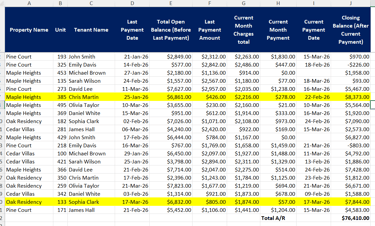
Looking at the sample tracker, several patterns emerge immediately:
Chris Martin at Maple Heights (Unit 385) is highlighted — last payment was 25-Jan-26, current month payment is only $278 against charges of $2,216, and the closing balance is $8,373. This tenant is significantly behind and the balance is growing.
Sophia Clark at Oak Residency (Unit 133) is also highlighted — last payment 17-Mar-26, current month payment just $57 against $1,874 in charges, closing balance $7,844.
These two tenants alone account for over $16,000 in outstanding balances. Without a tracker, these numbers are buried inside a total A/R figure. With a tracker, they are immediately visible and actionable.
This is exactly the kind of insight that allows a property owner to make informed decisions — whether that means a payment plan conversation, a formal notice, or a lease non-renewal.
Why A/R Visibility Protects Your Cash Flow
Most cash flow problems in rental property portfolios are not profitability problems. The properties are generating income. The issue is that the income is sitting with tenants rather than in the bank.
The sooner you see that clearly, the faster you can act. Here is what changes when you have a Tenant Health Tracker in place:
You stop chasing the wrong tenants. Instead of sending blanket reminders to every tenant, you focus collection efforts on the 2 or 3 accounts that actually matter for your cash position.
You make better leasing decisions. A tenant with a pattern of partial payments and growing balances is a risk you can see in the tracker months before they become a vacancy problem.
You have better conversations with investors. If you manage properties on behalf of partners or investors, a clean tracker gives you a transparent, professional view of receivables that builds trust and confidence.
You catch accounting errors faster. Negative balances, duplicate credits, and misapplied payments show up immediately in a well-structured tracker rather than sitting undetected in the books.
You sleep better. Knowing exactly where your cash is — and who is holding it — eliminates the anxiety of looking at a bank account that does not match your P&L.
How Brookeside Accounting Builds Your Tracker
We build custom Tenant Health and Delinquency Trackers for rental property owners and managers across the United States. Every tracker is:
Tailored to your portfolio — whether you have 5 units or 500, the tracker is structured around your specific properties, units, and tenant mix.
Integrated with your software — we pull data from Buildium, AppFolio, or QuickBooks Online and structure it into a clean, readable format. You do not need to do any manual data entry.
Updated on your schedule — weekly, bi-weekly, or monthly depending on your portfolio size and cash flow sensitivity.
Actionable from day one — we do not just hand you a spreadsheet. We walk you through what the numbers mean and where to focus your attention.
Shareable with stakeholders — formatted cleanly enough to send directly to investors, partners, or lenders without additional preparation.
The Question Every Rental Property Owner Should Ask
Before trying to fix your cash flow, improve your NOI, or refinance a property — ask one question:
Who is actually holding my money?
If you cannot answer that question with a specific list of tenant names and dollar amounts, you do not have enough visibility to manage your portfolio effectively.
A Tenant Health Tracker gives you that answer — clearly, quickly, and consistently.
Common Signs You Need a Tenant Health Tracker Right Now
Your bank balance consistently lags behind your P&L net income
You are not sure which tenants are behind on rent without running multiple reports
Your property management software shows a large A/R balance but you are not sure how old it is
You have had a surprise vacancy that revealed a much larger balance than expected
You manage more than 5 units and track tenant payments manually or in your head
You have investors or partners who ask about receivables and you do not have a clean answer ready
If any of these sound familiar, a structured tracker is the fastest way to get clarity.
Ready to see exactly who is holding your cash? Book a free consultation with Brookeside Accounting and we will build a custom Tenant Health Tracker for your portfolio.
Brookeside Accounting provides specialised real estate accounting services for rental property owners and managers across the United States, working remotely through Buildium, AppFolio, QuickBooks Online, and Xero.
Contact
Find us on LinkedIn and Facebook
Phone
contact@brookesideaccounting.services
+1 857-208-7210
© 2025. All rights reserved.
QUERIES