Utilities Payable Management for US Rental Property Owners in the Age of AI
From water, sewer, electric, and trash utilities payable to mortgage payment breakdowns, property tax, and insurance — here's how Brookeside manages AP for US rental property owners using automation-assisted, human-controlled accounting. Including our 1.5x overbilling alert.
UTILITIES PAYABLEACCOUNTS PAYABLE
Aditya Kumar
6/9/20268 min read
Utilities Payable Management for US Rental Property Owners in the Age of AI
I'll be upfront about something: I prefer human work. There's something assuring and comfortable in working with people you know and trust. There's also a precision and judgment that comes from a trained accountant serving US rental property owners — reviewing a bill, understanding the context behind a charge, and catching something that a system simply wouldn't flag. That's always been my baseline.
But the environment is truly changing. AI tools are becoming part of how accounting gets done — and the question is no longer whether to engage with them, but rather how to take advantage of these new tools in a way that does not negatively impact livelihoods, but rather ensures more productive employment. At Brookeside, the AI effect has been real. We have now mastered automation-assisted, human-controlled AP — delivering more accuracy, quicker turnaround times, and the time to spare to review work in higher detail than was ever possible before.
Here's what that looks like in practice.
The Scale Problem
We currently manage over 200 vendor accounts across our client portfolios. These span every category of recurring property expense — utilities payable (water, sewer, trash, electric, gas), mortgage payments, insurance premiums, HOA dues, software subscriptions, and more. And that's just the property-level bills.
At the management company level, there are additional recurring obligations — phone and internet, software platforms like Rent Manager, Expensify, and AvidPay, payroll processors like Gusto, insurance policies, and office expenses — each with their own vendor portal, account number, payment method, and billing cycle.
Every single one of these has a bill. Every bill has a due date, a charge amount, a payment method — autopay, AvidPay, check, or EFT — a property allocation, a unit allocation, an accounting treatment (expense, billback, or billback + expense), and a memo that needs to follow a consistent format.
Doing all of that manually, every month, across 200+ accounts is an enormous volume of data entry. And data entry, by its nature, is where errors accumulate — a wrong date here, a misallocated property there, an overpayment that gets expensed instead of going to the balance sheet as a prepaid.
That's the problem automation solves. Not the thinking — the volume.
What the Automation Does
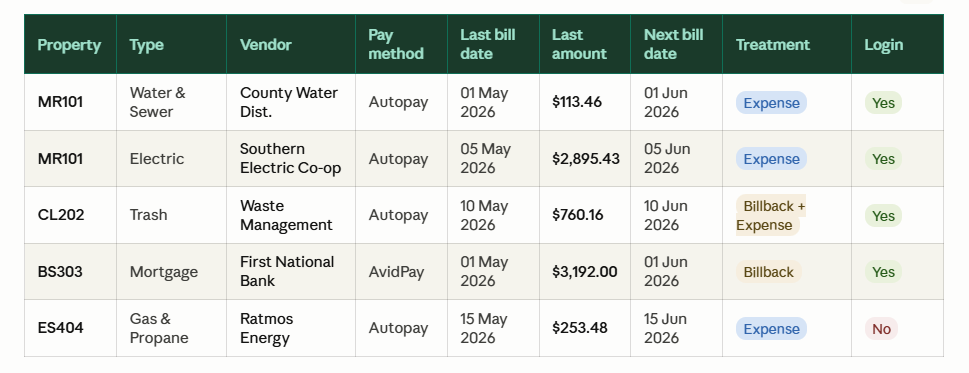
We maintain a comprehensive AP schedule for each client — a master tracker that captures every vendor, account number, payment method, last bill date, last bill amount, next bill date, login availability, accounting treatment, and operational notes. This schedule is the backbone of the entire AP workflow.
From there, we built a dedicated AP dashboard that handles the front end of the workflow. It pulls bills from accessible vendor portals, dumps them into a dedicated bills folder, and posts them into Buildium. The system processes the routine, repetitive part of the cycle — getting the right bill into the right place at the right time, across 200+ accounts.
Vendor Portal Access and Login Management
Managing AP for a US rental portfolio from offshore means solving a problem most clients never think about: vendor portal access. Every utility provider, insurance company, and software platform has its own login, and many require two-factor authentication tied to a US phone number.
We solved this systematically. We maintain a virtual US number through which we set up and manage vendor portal logins directly — meaning 2FA codes come to us without any involvement from the client. For the majority of accounts, we have full independent access to pull bills, check account balances, and verify charge amounts without a single back-and-forth.
For vendor portals that are tied to the client's personal number or require their direct authorization, we coordinate during EST business hours — so any request for a 2FA code or login assistance happens within the client's normal working day, not at an inconvenient hour.
Every account in our AP schedule is tagged with its login status — accessible, requires client coordination, or not available. This means we know before the billing cycle begins exactly which vendors need extra lead time, and we plan accordingly. No missed bills, no last-minute scrambles, and no payments delayed because a portal was inaccessible.
What I Review — And Why It Matters
This is where the human layer comes in, and it's non-negotiable.
Every bill that gets posted goes through a structured review before it moves forward. I check:
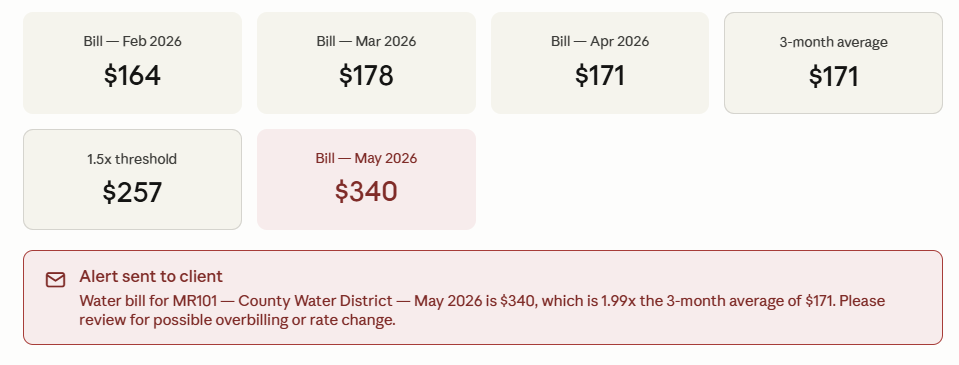
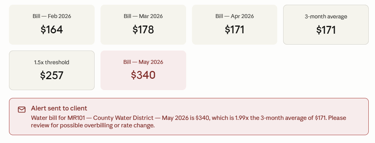
Bill dates and charge amounts — automation can pull the wrong billing period or miss a rate change. A $180 water bill that suddenly shows $340 needs a human to question it, not just post it.
The 1.5x alert — we flag any bill where the current charge is more than 1.5 times the average of the previous three charges for that account. When that threshold is breached, we send the client a direct email notification with the account details and the variance. This has caught utility overbilling, erroneous rate increases, and duplicate charges before they became recurring problems.
Overpayment treatment — if a vendor has been overpaid, that balance doesn't go to expense. It sits on the balance sheet as a prepaid — and the utilities payable account needs to reflect the correct outstanding balance at all times. An automated system will post it wherever it's told. I make sure it goes where it should.
Double bookings — the same bill posted twice is one of the most common AP errors in property management. Easy to miss in a high-volume workflow, easy to catch with a disciplined review process.
Property and unit allocation — in a multi-property portfolio, a bill needs to be allocated to the right property and the right unit. A misallocation doesn't just create a bookkeeping error — it distorts the income statement for that property and makes owner reporting inaccurate.
Accounting treatment — not every bill is a straight expense. Some are billbacks to the property owner, some are split between expense and billback, and some require specific balance sheet treatment. The AP schedule tracks the correct treatment for every account — and the review confirms it's applied correctly every time.
Memo discipline — every bill posted follows a consistent format: Property — Vendor — Account — Service Period. This sounds like a small thing. It isn't. When you're reconciling accounts or preparing for an audit, a clean, uniform memo field tells you exactly what a transaction is without having to dig through supporting documents. Inconsistent memos are a silent source of chaos in property accounting.
Mortgage payment breakdown — every mortgage payment is not simply an expense. It contains distinct components — principal, interest, escrow, property tax disbursements, and insurance disbursements — each of which needs to be recorded accurately and separately. We track every mortgage payment to ensure each component hits the right account. A mortgage payment posted as a single lump expense distorts your income statement, overstates your operating costs, and gives your CPA and your investors an inaccurate picture of your debt position and true operating performance.
Beyond the monthly payment, mortgage management also means staying on top of escrow analysis statements. Lenders review escrow accounts annually and adjust the required escrow contribution when property tax assessments or insurance premiums change. When that adjustment arrives, the new monthly escrow amount needs to be reflected correctly in the books — and any escrow shortage needs to be tracked on the balance sheet, not buried in expenses. This is a detail that gets missed constantly in property accounting, and it compounds quietly until year end when the CPA starts asking questions.
Insurance tracking — insurance premiums for rental properties are often paid through escrow as part of the mortgage payment, but they can also be billed separately depending on the lender and the policy structure. In either case, the premium needs to be correctly separated from the mortgage payment, allocated to the right property, and matched against the policy schedule. When a lender-paid insurance disbursement doesn't match what's on the books, that discrepancy needs to be caught and corrected before it flows through to the income statement. We track every insurance payment — whether it comes through escrow or direct billing — and reconcile it against the policy records.
Property tax documentation — every property tax payment in our AP workflow is supported by the actual tax bill. We go directly into the relevant property tax search portal, pull the bill, and attach it to the payment record — without any back and forth with you. No unsupported tax payments, no missing documentation at year end, and no scramble when your CPA asks for backup.
Utility billing cycles and reconciliation — water and sewer bills are often quarterly rather than monthly, which means a single bill can cover three months of consumption and needs to be correctly allocated across the right periods. Electric bills fluctuate seasonally — a property in Texas in August will look very different from February — and those variances need to be understood rather than just posted. Trash is typically fixed and predictable, which makes it one of the easier utilities to automate, but even fixed bills need to be checked against the AP schedule to confirm the rate hasn't changed. We track the billing cycle for every utility account so nothing falls through the gap between billing periods.
Check issuance — payments are only issued once they've cleared the bank. Not before. This prevents the cash position errors that come from issuing checks against funds that aren't yet available — the same kind of available balance problem we've written about elsewhere.
The Honest Truth About AI in Accounting
My team has more time now. Hours that used to go into data entry are now available for review, analysis, and client communication. That's a real benefit — not just for efficiency, but for output quality. More reviewed work means more accurate work. And accurate work is ultimately what a rental property owner is paying for.
But I won't pretend this transition has been seamless or that I've embraced it without reservation. I've had to adapt — and so has my team. There's a real learning curve in knowing when to trust the system and when to override it. There's also a responsibility that comes with putting your name on AI-assisted output: you have to review it carefully enough that it's genuinely yours.
Humans have always adapted to new tools. The accountants who thrived after spreadsheets replaced ledger books weren't the ones who refused to learn Excel — they were the ones who understood the numbers well enough to know when Excel was wrong. The same principle applies now. We are evolving. The work is better for it. But the judgment stays human.
What This Means for Your Portfolio
If you're a US rental property owner or property manager with a growing vendor base, the question isn't whether AI will touch your AP workflow — it probably already does, in some form. The question is whether there's a trained accountant reviewing the output before it becomes your financial record.
At Brookeside, that review is built into the process. The automation handles the volume. The accountant handles the accuracy. And when something looks wrong — a water, sewer, or electric bill that's jumped 1.5 times its usual amount, a utilities payable balance that's been incorrectly expensed, a mortgage payment that hasn't been properly broken down, an insurance disbursement that doesn't match the policy, or a property tax payment without documentation — you hear about it before it becomes a problem.
Book a call with us. If you'd like to understand how this works for portfolios like yours, we'd be happy to walk you through it in a free first review session.
Contact
Find us on LinkedIn and Facebook
Phone
contact@brookesideaccounting.services
+1 857-208-7210
© 2025. All rights reserved.
QUERIES